


Views: 0 Author: Site Editor Publish Time: 2025-01-20 Origin: Site


Large pipe bending plays a vital role in many industries, such as construction, oil and gas, and manufacturing. The ability to precisely shape pipes to meet complex designs is essential for ensuring the efficient operation and durability of pipelines and mechanical systems. Whether for structural uses, oil transportation, or large-scale manufacturing, pipe bending is a critical component of various industrial processes. Understanding the core principles and techniques of large pipe bending is crucial for businesses to enhance the performance and longevity of their pipework.
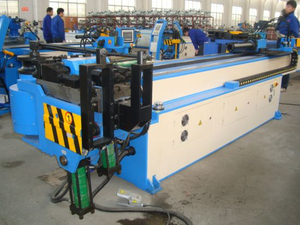
In this article, we will highlight the key rules for large pipe bending and introduce the GM-SB-168NCB Bending Machine, a high-precision, advanced tool that caters to the needs of bending large pipes in a range of profiles and sizes.
Large pipe bending involves more than just mechanical manipulation; it requires precision and a deep understanding of how pipes respond to bending forces. Whether bending pipes for construction, transportation, or industrial systems, achieving the correct bend is crucial to ensuring the structural integrity and functionality of the finished product. Improper bending can lead to defects that compromise the entire system's efficiency or result in failures.
This is where advanced machinery like the GM-SB-168NCB Bending Machine comes in. Equipped with a high-grade hydraulic system and an intuitive touchscreen interface, this machine provides the accuracy and reliability necessary for precise large pipe bending.
Pipe bending involves applying specific forces to a pipe to alter its direction or angle. Various techniques exist for bending pipes, each suitable for different materials, thicknesses, and applications. The main bending methods include:
· Cold Bending: The process of bending pipes at room temperature. This method is widely used due to its simplicity and the fact that it does not require additional heating.
· Hot Bending: Involves heating the pipe to high temperatures before bending. This method is ideal for materials that are harder to bend at room temperature.
· Rotary Bending: A machine-driven process where the pipe rotates while a bending die applies force to shape it.
The GM-SB-168NCB Bending Machine excels at handling all these bending methods, offering flexibility for both cold and hot bending applications. It is designed for both structural and mechanical pipe bending, making it a versatile tool for various projects.
One of the most crucial rules for large pipe bending is determining the minimum bend radius, which is the smallest radius a pipe can be bent without compromising its structural integrity. A smaller bend radius increases the risk of deformation or weakening, which could lead to failure.
The minimum bend radius is influenced by several factors:
· Pipe Material: Different materials have varying flexibility and resistance to deformation.
· Pipe Diameter: Larger pipes typically require a larger bend radius to avoid distortion.
· Wall Thickness: Thicker pipes require a larger bend radius to maintain strength and prevent damage.
The GM-SB-168NCB Bending Machine takes these factors into account, allowing for precise adjustments and optimal results. Its intuitive touchscreen interface simplifies the adjustment process, while its hydraulic system ensures consistent and accurate bending, regardless of the pipe material—whether metal, plastic, or composite.
Accurate bending angles are vital to the overall performance of the system, whether it involves fluid transportation, structural support, or mechanical functions. Incorrect bending angles can lead to poor fluid flow, structural instability, or inefficient mechanical operation.
The bending angle is typically calculated based on project specifications. Engineers need to consider factors like the overall system design, material flow (for pipelines), or load-bearing capacity (for structural applications).
The GM-SB-168NCB Bending Machine is capable of precise angle control with minimal deviation, ensuring that bending tolerances are met without sacrificing quality. The machine's advanced control system facilitates easy angle adjustments to meet project requirements while guaranteeing repeatable accuracy.
There are various types of bending equipment, ranging from manual tools to fully automated systems. The choice of equipment depends on factors such as pipe size, material, and specific bending requirements.
The GM-SB-168NCB Bending Machine is a hydraulic machine designed for high-precision large pipe bending. Key features include:
· Hydraulic System: The machine uses imported components to ensure smooth and reliable hydraulic operations, reducing the risk of failure and ensuring consistent bending results.
· Linear Guide Way: Taiwan-made linear guides ensure the smooth movement of the bending arm, essential for maintaining precision throughout the bending process.
· Touch-Screen Interface: The industrial-grade touchscreen simplifies complex bending tasks by allowing users to input specifications and monitor progress in real-time, minimizing deviation from the target bending parameters.
With these features, the GM-SB-168NCB Bending Machine offers reliable and high-performance bending, even for large, heavy-duty pipes that demand precision.
Several factors influence how a pipe behaves during the bending process, including:
· Material Composition: The type of material (e.g., steel, aluminum, copper, plastic) determines its ability to bend without cracking or weakening.
· Pipe Thickness: Thicker pipes require more force to bend and are more prone to damage if the bend radius is too small.
· Environmental Conditions: Temperature and humidity can affect bending, particularly with hot bending.
The GM-SB-168NCB Bending Machine is equipped with advanced hydraulic technology that adapts to different materials and thicknesses, making it ideal for various bending tasks. The flexibility of the machine allows businesses to tailor their processes to meet the demands of different pipe materials and specifications.
Mastering large pipe bending requires a deep understanding of factors such as bend radius, angle, material properties, and the appropriate bending equipment. By following these fundamental rules, businesses can ensure that their pipes are bent with precision and the highest quality standards.
The GM-SB-168NCB Bending Machine offers a comprehensive solution for businesses looking to enhance their pipe bending capabilities. With its combination of precision, automation, and durable components, it guarantees high-quality results for structural, mechanical, and industrial applications.
For businesses seeking a reliable, efficient, and precise pipe bending solution, the GM-SB-168NCB Bending Machine is the ideal choice. Incorporating this cutting-edge technology into operations will reduce costs, boost efficiency, and ensure the long-term success of projects.
If you're ready to upgrade your pipe bending capabilities or simply want to learn more about the GM-SB-168NCB, feel free to reach out. Our team is available to answer any questions and help you find the best solution for your pipe bending needs.