


Views: 0 Author: Site Editor Publish Time: 2026-10-09 Origin: Site


Ever wondered how metal pipes get perfectly curved without damage? Pipe bending machines make this possible. They are vital in many industries for shaping pipes accurately and efficiently. In this post, you’ll learn what a pipe bending machine is, how it works, and why it’s essential in modern manufacturing.
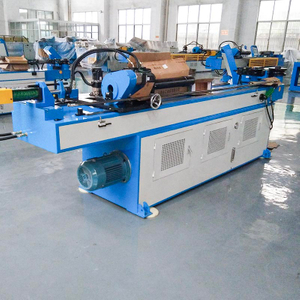
Pipe bending machines are designed to shape metal pipes or tubes into specific angles or curves without damaging the material. They work by applying controlled force to bend the pipe around a shaped tool called a die, ensuring the pipe maintains its strength and shape.
At its core, a pipe bending machine bends a pipe by clamping it firmly and then forcing it to follow the contour of a bending die. As the pipe bends, the outer wall stretches while the inner wall compresses. Without proper support, this can cause kinking, wrinkling, or collapsing.
The machine supports the pipe throughout the process to prevent these issues. It holds the pipe in place and applies force smoothly to achieve the desired bend radius and angle.
Several parts work together to ensure a smooth, precise bend:
Bend Die: The core component that sets the radius of the bend. The pipe wraps around this die during bending.
Clamp Die: Holds the pipe tightly against the bend die to prevent slipping.
Pressure Die: Supports the pipe’s outer surface as it moves through the bend, keeping it straight before and after the bend.
Wiper Die: Positioned on the inside radius of the bend, it prevents wrinkles by supporting the compressing inner wall.
Mandrel: A tool inserted inside the pipe during bending. It provides internal support, especially for thin-walled pipes or tight bends, preventing collapse or deformation.
Manual Pipe Benders: These rely on the operator’s physical effort, using levers and simple dies. They are suitable for small-diameter pipes and low-volume work but lack precision and repeatability.
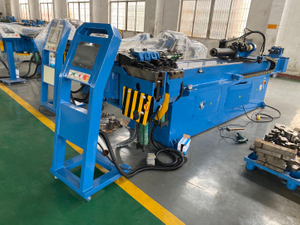
Industrial Pipe Bending Machines: Powered by hydraulics or electric servos, these machines offer greater force, control, and accuracy. They can handle larger pipes and complex bends, often equipped with CNC controls for automation and consistency.
During bending, the pipe’s outer wall is stretched, and the inner wall is compressed. Without support, this causes:
Kinking: Sharp folds or bends that weaken the pipe.
Wrinkling: Inner surface creases due to compression.
Collapsing: Flattening or deformation of the pipe’s cross-section.
Pipe bending machines use the combination of clamp, pressure, and wiper dies along with mandrels to maintain the pipe’s shape. The clamp die prevents slipping, the pressure die supports the outer wall, and the wiper die smooths the inner wall. Mandrels provide internal support to keep the pipe round, especially on tight bends or thin materials.
Note: Choosing the right combination of dies and mandrels is crucial to avoid defects and ensure high-quality bends in different pipe materials and thicknesses.

Pipe bending machines differ in power, automation, accuracy, and production capacity. The right choice depends on pipe size, bend complexity, output volume, and tolerance requirements.
Machine Type | Operation | Main Advantages | Limitations | Typical Applications |
|---|---|---|---|---|
Manual pipe bender | Uses hand force and mechanical leverage | Portable, simple, and affordable | Limited power, accuracy, and repeatability | Plumbing, electrical conduit, and occasional repairs |
Hydraulic pipe bender | Uses hydraulic pressure to apply bending force | Handles thicker walls and larger pipes with consistent force | Slower cycles and regular hydraulic maintenance | Structural fabrication and general workshop production |
NC pipe bender | Automatically controls bending angles, while feeding and rotation remain manual | Better repeatability at a moderate investment | Limited automation and complex-bend capability | Small and medium production runs |
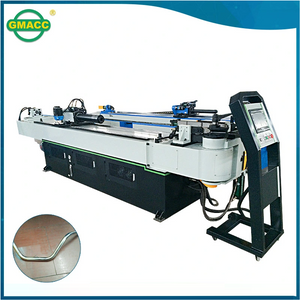
CNC pipe bender | Automatically controls bending, feeding, and rotation | High accuracy, fast output, and consistent complex bends | Higher purchase cost and programming requirements | Automotive, aerospace, furniture, and volume production |
Roll bender | Uses rollers to form gradual curves | Produces large-radius bends with limited deformation | Unsuitable for tight or sharp bends | Handrails, arches, frames, coils, and structural sections |
Manual and hydraulic machines suit simpler or lower-volume work. NC machines provide partial automation, while CNC systems support complex, high-volume production. Roll benders are the best choice for smooth, large-radius curves.
Pipe bending machines play a crucial role across many industries. They enable manufacturers to create precise, durable, and functional curved pipes and tubes, which are essential components in a variety of products and systems. Here’s a closer look at the main industries that rely on pipe bending machines and how they use them.
In automotive manufacturing, pipe bending machines shape exhaust systems, fuel lines, and structural parts like roll cages and chassis components. Precision is vital here because bent pipes must fit tightly into complex assemblies without leaks or structural weaknesses. CNC pipe benders often produce these parts to ensure accuracy and repeatability, improving vehicle performance and safety.
Mechanical engineers use pipe bending machines to fabricate components for industrial machinery and hydraulic systems. Bent tubes serve as conduits for fluids and gases or as structural elements within machines. The ability to produce complex bends without weakening the pipe allows for more compact and efficient machine designs. Hydraulic systems especially benefit from smooth bends that reduce pressure loss and prevent leaks.
In furniture making, bent metal tubes form frames for chairs, tables, and decorative structures. Aesthetic appeal and structural integrity are both important. Pipe bending machines help manufacturers create smooth, consistent curves that enhance the design and strength of metal furniture. CNC machines enable the production of complex, multi-bend parts that meet both functional and artistic requirements.
Agricultural equipment often incorporates bent pipes for structural supports, frames, and hydraulic lines. These parts must withstand harsh environments and heavy use. Pipe bending machines allow manufacturers to produce durable components that fit precise specifications, improving equipment reliability and ease of assembly.
In metal construction, bent pipes form tubular structures such as guardrails, handrails, and architectural features. The ability to create large-radius bends or complex shapes enhances both safety and visual appeal. Roll benders are often used here to produce smooth, sweeping curves for architectural applications. Consistency and quality are essential to meet building codes and design standards.
Heating, ventilation, air conditioning (HVAC), and fluid conduction systems rely heavily on bent pipes for ductwork, piping networks, and connectors. Smooth bends help maintain efficient airflow or fluid flow, reducing energy loss and noise. Pipe bending machines produce these components quickly and accurately, supporting large-scale installations and maintenance work.
Tip: When selecting a pipe bending machine for your industry, consider the specific pipe sizes, materials, and bend complexities your applications require to ensure optimal performance and cost-efficiency.
Pipe bending machines improve production quality, speed, and efficiency. They also reduce waste and manufacturing costs.
Advantage | Simple Explanation |
|---|---|
High accuracy | Controls bend angles and radii for consistent results |
Less waste | Reduces wrinkles, kinks, and incorrect bends |
Faster production | Produces repeated bends quickly with less manual work |
Stronger parts | Creates continuous pipes with fewer joints and welds |
Lower costs | Reduces cutting, welding, assembly, and inspection work |
Better appearance | Produces smooth, clean curves |
Flexible designs | Creates complex shapes for different applications |
These advantages make pipe bending machines useful in automotive, aerospace, furniture, construction, and industrial manufacturing.
Pipe bending involves several methods, each suited to different pipe shapes, materials, and bend requirements. Understanding these processes helps select the right technique for quality, efficiency, and cost-effectiveness.
Rotary draw bending is one of the most accurate bending methods. The pipe is clamped to a bend die, which rotates to form the bend. This method uses a set of dies including a clamp die, pressure die, and wiper die to support the pipe and prevent defects like wrinkles or kinks.
It’s ideal for tight-radius bends and complex shapes, commonly used in automotive exhaust systems, hydraulic lines, and furniture frames. The precision of rotary draw bending ensures consistent angles and radii, making it perfect for high-quality production runs.
Press bending involves pushing the pipe against a shaped die using a hydraulic press. The pipe bends to match the die's contour. This process is simpler but less precise than rotary draw bending.
It’s often used for large radius bends or when slight deformation is acceptable. Typical applications include structural steel components or large-diameter pipes where aesthetic finish is less critical.
Roll bending uses three rollers to gradually curve the pipe. The pipe passes through adjustable rollers that apply pressure, creating smooth, sweeping bends with large radii.
This technique causes minimal cross-sectional deformation, preserving pipe integrity. It’s widely used in architectural structures, handrails, and tubular frameworks where gentle curves are needed over long lengths.
Induction bending heats a localized pipe section using an induction coil. The heated area becomes pliable, allowing it to be bent with controlled force. After bending, the pipe cools, retaining the new shape.
This process suits thick-walled pipes or large diameters where cold bending risks cracking or excessive deformation. Industries such as petrochemical and power generation use induction bending for pipelines and structural components.
Mandrels are internal supports inserted into pipes during bending. They help maintain the pipe’s shape by preventing collapse, wrinkling, or excessive thinning, especially with thin walls or tight bends.
Different mandrel types include plug mandrels, ball mandrels, and form mandrels, each suited to specific bend complexities.
Bending springs are flexible tools inserted inside pipes during manual bending to support the walls and avoid flattening. They are common for small-diameter copper or PVC pipes in plumbing.
Packing methods fill the pipe internally to support it during bending:
Ice Packing: The pipe is filled with a water solution, frozen, then bent cold. The frozen core supports the pipe walls, preventing deformation. Used for delicate bends, like in musical instruments.
Pitch Packing: An older method using pitch to fill the pipe. It provided good support but was hard to clean and is now mostly obsolete.
Sand Packing: Fine sand fills the pipe, which is then heated and bent. The sand resists deformation internally, maintaining cross-section integrity. Used for hot bending processes like hot-slab forming.
Tip: Choose bending techniques and internal supports based on pipe material, wall thickness, and bend radius to minimize defects and ensure high-quality bends.
Pipe bending machines are essential for precise, efficient metal pipe shaping in modern manufacturing. They reduce waste, improve quality, and speed up production. Investing in the right technology boosts cost savings and product durability. Businesses should carefully assess their needs and consult experts to find optimal solutions. Zhangjiagang King Macc offers advanced pipe bending machines that deliver accuracy and reliability, helping companies enhance productivity and meet industry standards. Consider their expertise to upgrade your manufacturing processes effectively.
A: A pipe bending machine is equipment designed to shape metal pipes or tubes into specific angles or curves without damaging them, using dies and controlled force.
A: It uses clamp, pressure, and wiper dies along with mandrels to support the pipe internally and externally during bending, preventing kinking, wrinkling, and collapsing.
A: CNC machines offer higher precision, automation, and repeatability, ideal for complex bends and high-volume production compared to manual pipe bending machines.
A: Price depends on machine type (manual, hydraulic, CNC), pipe size capacity, automation level, and included tooling or accessories.
A: Check for improper die setup, worn tooling, incorrect mandrel use, or insufficient clamping pressure to avoid defects like wrinkles or kinks.