


Views: 0 Author: Site Editor Publish Time: 2026-09-01 Origin: Site


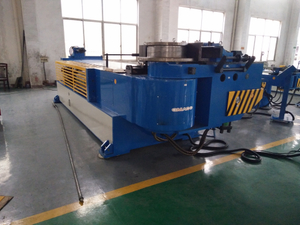
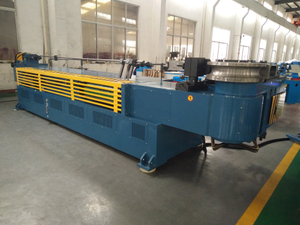
An aluminum pipe bending machine is a practical choice when manufacturers need to form aluminum tubes into accurate, repeatable curves without excessive flattening, wrinkling, cracking, or surface damage. Although aluminum is lighter and often easier to form than many steels, it still requires careful control of bend radius, tooling, clamping force, machine speed, and springback.
For automotive parts, HVAC tubing, furniture, structural frames, transportation components, and other fabricated aluminum products, manual bending can quickly become inconsistent once production volume or geometry becomes more demanding.
A properly selected pipe bending machine gives manufacturers much greater control over the process.
The main reasons to choose one are simple:
better bend consistency, reduced deformation, higher production efficiency, easier repeat production, and more precise control over complex tube geometry.
Aluminum is not simply a lighter version of steel.
Its lower density is one of its biggest industrial advantages, but different aluminum alloys can respond very differently during bending. Some grades are relatively ductile, while others can be more sensitive to cracking, surface marking, or excessive springback.
Wall thickness is equally important.
A thick-wall aluminum tube with a large bend radius may be relatively straightforward to form, while a thin-wall tube bent to a tight radius can require internal support and carefully matched tooling.
This means successful aluminum bending depends on several variables working together:
aluminum alloy and temper,
outside diameter,
wall thickness,
centerline radius,
bend angle,
tube profile,
tooling design,
and machine control.
A dedicated or properly configured aluminum pipe bending machine allows these variables to be managed much more consistently than improvised bending methods.
One of the strongest reasons to use a machine is deformation control.
During bending, the outside wall of an aluminum tube stretches while the inside wall is compressed. If the tube is not supported correctly, several defects can appear.
Typical problems include:
Flattening — the round tube becomes noticeably oval.
Wrinkling — compressed material gathers along the inside radius.
Wall thinning — the outside wall becomes thinner as it stretches.
Cracking — excessive strain exceeds what the alloy can tolerate.
Surface marking — tooling leaves scratches or pressure marks on visible aluminum surfaces.
A pipe bending machine cannot eliminate these problems automatically, but it gives the operator or control system a much better way to manage them through tooling, clamping, pressure, radius, and bending speed.
For parts where appearance or internal flow area matters, this control can significantly improve finished-product consistency.
Repeatability becomes increasingly important as production volume rises.
Suppose a manufacturer needs 500 aluminum tubes, each containing three bends. If those angles vary from part to part, the problem may not appear until final assembly.
Small variations can lead to:
poor fit-up,
welding difficulty,
fixture problems,
inconsistent finished dimensions,
and additional rework.
A CNC or automatic bending machine can store programmed bend parameters and repeat them across multiple parts.
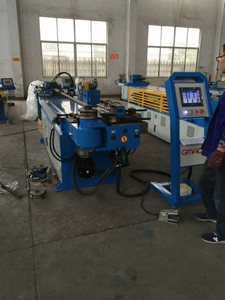
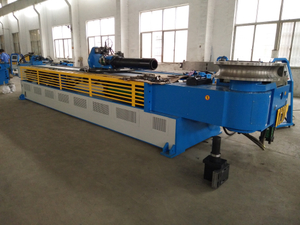
GMACC Machinery's current pipe-bending range includes CNC and automatic configurations that use programmable control for feeding, rotation, bending angle, and production sequences. The company's product information also lists aluminum among the tube materials processed by its CNC pipe-bending equipment.
For high-volume work, this repeatability is one of the main reasons to move beyond manual bending.
Manual or basic bending methods may be adequate for occasional fabrication, but they become less efficient when factories repeatedly produce the same aluminum component.
An automated bending process can reduce the number of manual operations required for:
feeding → positioning → rotating → clamping → bending → releasing
Depending on the machine configuration, several of these movements can be controlled automatically.
This reduces operator handling between bends and makes cycle times more predictable.
For manufacturers producing components such as aluminum frames, handles, furniture structures, automotive tubing, or HVAC assemblies, even a small reduction in cycle time can become significant over thousands of parts.
The right question is therefore not only:
How fast can the machine make one bend?
A better production question is:
How efficiently can it produce a complete acceptable part repeatedly?
Simple aluminum parts may contain only one or two bends.
Other products require multiple angles in different planes.
For these parts, the machine may need to:
feed the tube forward,
bend it,
rotate it,
feed again,
produce another angle,
and repeat the sequence until the part is complete.
Manual positioning creates more opportunities for cumulative dimensional error.
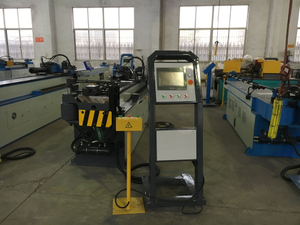
A CNC pipe bending machine can coordinate these movements according to a stored program. GMACC Machinery currently lists 3-axis, 5-axis, automatic, hydraulic, and other CNC pipe-bending configurations, with aluminum included among the applicable tube materials.
This makes CNC equipment especially useful for complex three-dimensional aluminum parts.
Not every aluminum tube is hidden inside a machine.
Many fabricated products use exposed aluminum because of its clean appearance, corrosion resistance, and relatively low weight.
Examples include:
furniture frames,
handrails,
decorative structures,
transport components,
architectural products,
and consumer equipment.
In these applications, a technically correct bend can still be unacceptable if the surface is scratched, crushed, or heavily marked.
Machine setup therefore needs to consider tooling contact as well as bend geometry.
Correct die design, clean tooling, suitable lubrication where required, proper clamping force, and controlled handling can help reduce cosmetic damage.
For manufacturers supplying finished or visible aluminum components, surface quality can be just as important as bend-angle accuracy.
Not every factory needs the same degree of automation.
A smaller fabrication shop may prioritize flexibility and economical operation. A high-volume OEM supplier may prioritize cycle time, automation, and repeatability.
A simple comparison looks like this:
Production Requirement | Typical Machine Direction |
|---|---|
Occasional simple aluminum bends | Electric or basic hydraulic bender |
Medium-volume repeated parts | NC / hydraulic bending machine |
High-volume aluminum production | Automatic pipe bending machine |
Complex multi-angle components | CNC pipe bending machine |
Tight-radius thin-wall tubing | Mandrel-capable CNC machine |
Symmetrical frame components | Double-head bending machine |
This is only a starting point. Actual machine selection must still be based on tube dimensions, alloy, bend radius, and required production quality.
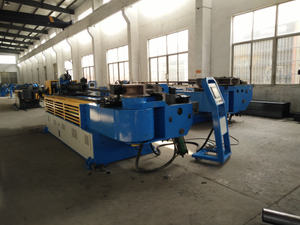
GMACC Machinery's current pipe bending machine range includes hydraulic, CNC, automatic, electric, aluminum, single-head, and double-head categories.
Thin-wall aluminum tube can be especially sensitive to collapse and ovality.
When the bend radius becomes tight relative to tube diameter, internal support may be necessary.
A mandrel is inserted inside the tube near the bend area to support the cross-section as the material forms around the bend die.
Depending on the application, a mandrel can help reduce:
flattening,
wrinkling,
excessive ovality,
and local collapse.
A wiper die may also be used to control wrinkling near the tangent point.
However, not every aluminum part requires mandrel bending.
A thick-wall tube with a generous radius may bend successfully without one. Whether a mandrel is necessary depends on the tube geometry and quality requirement rather than the material name alone.
For buyers, this is an important distinction because mandrel capability affects both machine configuration and tooling cost.
Aluminum tubing appears in many industries because it combines relatively low weight with good corrosion resistance and useful forming characteristics.
Weight reduction is a major reason aluminum is used in transportation.
Bent aluminum tubes and profiles can appear in:
structural frames,
seat components,
fluid lines,
heat-management systems,
support structures,
and specialty vehicle assemblies.
Production repeatability is especially important when parts must fit into automated assembly or welding fixtures.
Aluminum and other non-ferrous tubes are used in cooling and heat-transfer systems.
In these applications, excessive tube flattening can reduce internal flow area, making bend quality more than a cosmetic issue.
Controlled bending helps maintain the required tube shape through elbows and routing changes.
Aluminum is widely used where both appearance and low weight matter.
Bent tubing may be used in:
chairs,
tables,
outdoor furniture,
handrails,
display systems,
frames,
and decorative structures.
Here, consistent geometry and surface condition often become key purchasing criteria.
General fabrication companies use aluminum bending equipment for protective frames, handles, enclosures, machinery components, and custom assemblies.
Because product types can change frequently, flexible tooling and programmable machines can be especially useful.
Manual bending still has a place.
For prototypes, repairs, or very small production quantities, a basic manual method may be perfectly reasonable.
The limitations become more obvious when the job requires:
repeated identical parts,
several bends per tube,
tighter dimensional tolerance,
thin-wall material,
controlled ovality,
high daily output,
or complex three-dimensional geometry.
At that point, the labor required to measure, position, bend, inspect, and correct each part can outweigh the cost advantage of simpler equipment.
A machine therefore becomes valuable not because aluminum is impossible to bend by hand, but because production needs become harder to control manually.
Machine selection should begin with the actual part rather than the machine brochure.
These parameters influence machine capacity and tooling requirements.
Do not assume that two aluminum pipes with the same outside diameter require the same bending force. Wall thickness can change the forming load significantly.
Tighter radii generally increase deformation risk.
If your component requires a small centerline radius relative to tube diameter, discuss mandrel and wiper-die requirements with the supplier.
Different aluminum alloys and heat-treatment conditions have different ductility and springback behavior.
Providing the exact material grade gives the machine supplier more useful information than simply stating “aluminum.”
A one-bend tube does not need the same automation as a part with eight bends in multiple planes.
Consider:
number of bends,
angle of each bend,
rotation between bends,
distance between bends,
and total tube length.
A machine for 50 parts per month can be very different from equipment for several thousand parts per shift.
The more clearly the required output is defined, the easier it becomes to determine whether hydraulic, NC, CNC, or fully automatic equipment is justified.
A useful inquiry should include enough information for the supplier to evaluate both machine capacity and tooling.
Prepare:
aluminum alloy,
outside diameter,
wall thickness,
tube shape,
maximum tube length,
minimum centerline radius,
bend angles,
number of bends,
2D or 3D drawing,
required tolerance,
surface requirements,
and target production rate.
A sample part or product photo can also help.
GMACC Machinery states that customers can provide sample-model photos so its team can recommend a suitable machine.
This is far more useful than asking only:
“How much is an aluminum pipe bending machine?”
For a procurement manager, machine price should not be the only comparison point.
The larger cost picture includes:
Cost Factor | Why It Matters |
|---|---|
Cycle time | Determines output per shift |
Scrap rate | Poor bends consume tubing and labor |
Tooling change time | Affects flexible production |
Labor requirement | Influences operating cost |
Rework | Inconsistent bends increase secondary work |
Setup repeatability | Matters when jobs return later |
Maintenance | Affects machine availability |
Technical support | Reduces downtime during commissioning and troubleshooting |
A lower-priced machine may become more expensive if it produces unstable bends, requires excessive manual correction, or cannot meet the required production volume.
For professional buyers, the better comparison is often total production cost per acceptable part.
GMACC Machinery supplies pipe and tube bending equipment under the GMACC product range. Its current portfolio includes CNC, hydraulic, automatic, electric, single-head, double-head, and aluminum-capable bending machines. The company states that it can recommend suitable equipment based on customer sample photos and application information.
The company's CNC bending equipment lists aluminum together with copper, stainless steel, carbon steel, alloy, and exhaust tubing among its applicable materials.
For buyers comparing equipment, the main pipe bending machine page provides access to different levels of automation and bending configurations.
A suitable machine recommendation should be based on your actual tube and finished part rather than a generic aluminum-bending specification.
Yes. Many pipe bending machines can bend aluminum when the machine capacity, tooling, bend radius, and operating parameters are appropriate for the alloy and tube dimensions.
It can require less forming force in some applications, but that does not automatically make aluminum bending simple. Alloy, temper, wall thickness, radius, cracking risk, surface condition, and springback still need to be controlled.
Not always. Mandrels are typically considered when thin walls, tight bend radii, or strict ovality requirements make internal support necessary.
Yes. CNC machines can be configured for aluminum tubing and are especially useful for multi-bend components that require repeatable feeding, rotation, and bend angles.
Use the correct bend radius, tooling, machine setup, and support system. Tight-radius or thin-wall tubes may require a mandrel or other deformation-control tooling.
Provide the aluminum alloy, outside diameter, wall thickness, tube shape, bend radius, bend angles, part drawing, production volume, and tolerance requirements.
It can be worthwhile when production volume is high or when parts require repeated bends. The decision should be based on labor, output, scrap, setup, and total cost per acceptable part rather than automation alone.
Choosing an aluminum pipe bending machine is mainly about gaining control and repeatability.
The right machine can help manufacturers produce cleaner bends, reduce flattening and wrinkling, improve dimensional consistency, protect visible surfaces, and shorten production cycles.
For simple, occasional work, basic equipment may be enough. For thin-wall tubing, tight radii, complex multi-angle parts, or high-volume production, CNC, automatic, or mandrel-capable equipment can provide much greater process control.
Before purchasing, define the complete application:
alloy → diameter → wall thickness → bend radius → part geometry → tolerance → production volume
If you need help selecting a machine for an aluminum tube project, send GMACC Machinery your drawing, material specifications, tube dimensions, and production requirements.